A Winter Window, Read in Layers
A winter window observation exercise helps you see how daylight, curtains, and nearby surfaces alter a room’s feel before you buy or rearrange anything.
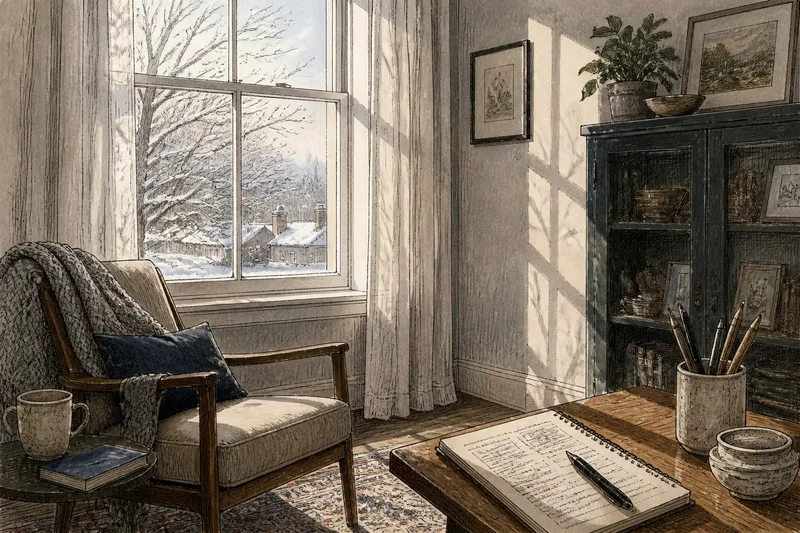
A winter window observation exercise can show why the same room feels clear in the morning and subdued by afternoon, without buying anything. Follow the changing light from the glass to the fabrics and surfaces nearby; the room’s character often comes from those layers working together, not from the window alone.
1. Choose one room
Pick a room you use regularly, then choose one window and the area around it as your focus. Keep the scope small enough to notice changes: a chair beside the window, a rug below it, or a painted wall across from it. You are observing the room as it already is, not designing a new scheme.
Begin with a familiar view. Sit or stand where you usually spend time, and note what first catches your attention: the window frame, a curtain edge, a bright patch on the floor, or a dark piece of furniture. Avoid deciding whether the room is attractive or unattractive. A neutral first note makes it easier to see what changes later.
Try to observe on a day when you can return to the room at different points. If the weather shifts, record that too. Cloud cover, rain, and snow can soften or reflect daylight, so a clear day is not the only useful one. The aim is to recognize patterns, not to create identical viewing conditions.
Keep a scrap of paper nearby. A few plain words—“bright floor,” “gray curtain,” “glare on table”—will be more useful than a polished description.
2. Watch the daylight
Look at the room at several ordinary moments, such as morning, midday, and late afternoon. Notice where daylight appears to enter, where it lands, and which parts remain comparatively dim. The sun may move across a wall or floor, while cloud cover may turn a sharp-edged patch into a broad, quiet glow.
Pay attention to direction as well as brightness. Light striking a wall from the side can make plaster, wood grain, or woven fabric look more pronounced. Light coming through the window and falling directly on a glossy table may create a bright reflection that draws the eye. A north-facing room, a shaded window, and an unobstructed south-facing one will each have different patterns, so record what your own room does rather than relying on a general rule.
Imagine you usually read beside a window in the morning, but the page looks flatter by afternoon. You note that the bright patch has moved off the book and onto a pale rug. That observation does not call for a new lamp or a purchase; it identifies how the room’s daylight shifts and where its visual emphasis goes.
Write down the time and a simple sky description. “Late afternoon, overcast” gives useful context when you compare the room’s appearance later.
3. Read the coverings
Window coverings filter, reflect, and frame daylight. Observe curtains, blinds, shades, or shutters in their usual position first. A sheer curtain can spread light across a wider area, while heavier fabric may make the window read as a stronger, darker block. Slats can cast lines that change as the light angle shifts.
Then notice whether you routinely leave the covering partly open, fully open, or closed. If it is comfortable and safe to do so, briefly compare the room with the covering in a different ordinary position, then restore it. This is an observation, not a recommendation to leave a window exposed. Notice the change in contrast around the frame, the view, and nearby furnishings.
Consider the covering’s color and texture. A warm-toned curtain may make the edge of the window feel softer, while a crisp pale shade may blend into a light wall. A patterned fabric can become more noticeable when daylight passes through it, even if the pattern seems quiet in dim conditions.
Look for practical signs as well: glare on a screen, a reflection in a framed picture, or a curtain that visually crowds a narrow wall. Record what happens before considering whether any adjustment would suit how you use the room.
4. Track nearby surfaces
Follow the light beyond the window covering. A pale wall may return light into the room, while a dark bookcase can absorb attention and make the adjacent area feel more enclosed. Wood, stone, glass, metal, and fabric each respond differently: grain catches angled light, glass reflects it, and matte textiles tend to soften its appearance.
Check surfaces at different distances from the window. A tabletop may show a bright reflection, while the wall behind it remains evenly lit. A rug might appear muted in the morning and more textured later, as light skims across its pile. These are changes in appearance, not changes to the materials themselves.
Notice colors in context rather than judging them in isolation. A warm wood floor can look more amber beside cool daylight; a gray cushion may seem bluer against a cream wall. Nearby colors influence what your eye perceives, so a sample or object viewed elsewhere may not look the same in this spot.
Choose one surface that seems to shape the room most. Note what it is, where it sits, and what the light is doing when you notice it. That gives you a concrete point of reference for the next observation.
5. Compare the room’s mood
Use ordinary, descriptive words for the room’s feel: calm, crisp, dim, busy, soft, or stark. Then connect each word to something visible. “Stark because the bright window contrasts with the dark cabinet” is more useful than “the room feels wrong.” It points to a relationship you can assess without assuming that anything needs to be replaced.
Compare the same seat or standing spot each time. Ask whether the window dominates, whether the surrounding surfaces seem balanced, and whether the view outside competes with objects inside. A change in cloud cover may alter all three, so include the sky condition in your notes.
Also consider the room’s use at that moment. A bright patch may feel welcome while you are having breakfast but distracting when you are trying to watch a screen. The observation is not a verdict on the light; it helps you distinguish a visual preference from a practical inconvenience.
Say you notice that late-day light reflects from a glass cabinet door toward the sofa. You jot down the time, the reflection, and where you were sitting. The expected observable result of this exercise is a clearer account of when and where the reflection appears, giving you a basis for deciding whether a small adjustment to your usual seating or covering position is worth trying.
6. Keep a short record
A useful record is brief enough to repeat. For each observation, write:
- Time and sky: morning, afternoon, clear, cloudy, or changing.
- Viewpoint: the chair, doorway, or part of the room where you stood.
- Window layer: covering position and any visible shadow or reflection.
- Surface: the wall, floor, furniture, or fabric that caught your attention.
- Effect: what looked brighter, darker, warmer, cooler, or more prominent.
Keep each note factual before adding an impression. “Sun patch on the oak floor; rug looks lighter beside it” separates what you saw from what you felt about it. If you sketch the room, simple arrows can show the apparent path of daylight; the drawing need not be to scale.
After several observations, read the notes together. Look for repeated conditions rather than trying to turn one unusual afternoon into a general rule. Perhaps the room’s strongest contrast appears only when the covering is open and the sky is clear. Or perhaps the wall looks more textured whenever light reaches it from the side.
Leave the furniture and objects where they are during this observation period. Changing several things at once makes it harder to tell which layer shaped your impression.
What does winter light change?
Why does the room look different later in the day?
The angle and direction of daylight change as the day progresses, shifting bright areas and shadows. Clouds also soften contrast, so the same wall or furnishing can appear different under a changing sky.
Do curtains change the color of daylight?
Fabric can tint or soften light passing through it, and its own color may appear more noticeable near a bright window. Compare the room with the covering in its usual positions and observe the surrounding surfaces as well as the fabric.
Why do nearby materials look different by the window?
Materials reflect, absorb, or scatter light in different ways, while neighboring colors affect how each surface is perceived. Angled daylight may also reveal texture that is less visible under softer, more even light.
Should I change anything after observing?
Not necessarily. Use your notes to decide whether a small, reversible change in an everyday habit might help, such as adjusting a covering when glare appears, and observe the result before considering a larger decision.
Turn notes into choices
Once you can describe the pattern, make one modest change only if it addresses a specific issue. You might shift a chair slightly to avoid a recurring reflection, or draw a curtain partway when direct glare appears. Keep the change easy to reverse, then notice whether the room works better for the activity you had in mind.
If nothing is bothering you, the observation still has value. You may discover that a dim corner is simply a late-afternoon condition, or that a favorite surface looks especially rich when winter daylight reaches it from the side. There is no need to solve a room that is already serving you.
A winter window observation exercise is most useful when it leaves you with a precise description: which light, through which covering, changed the appearance of which surface. That small piece of evidence can keep a future room decision grounded in what you actually see at home.